originally posted on 4/29/2024
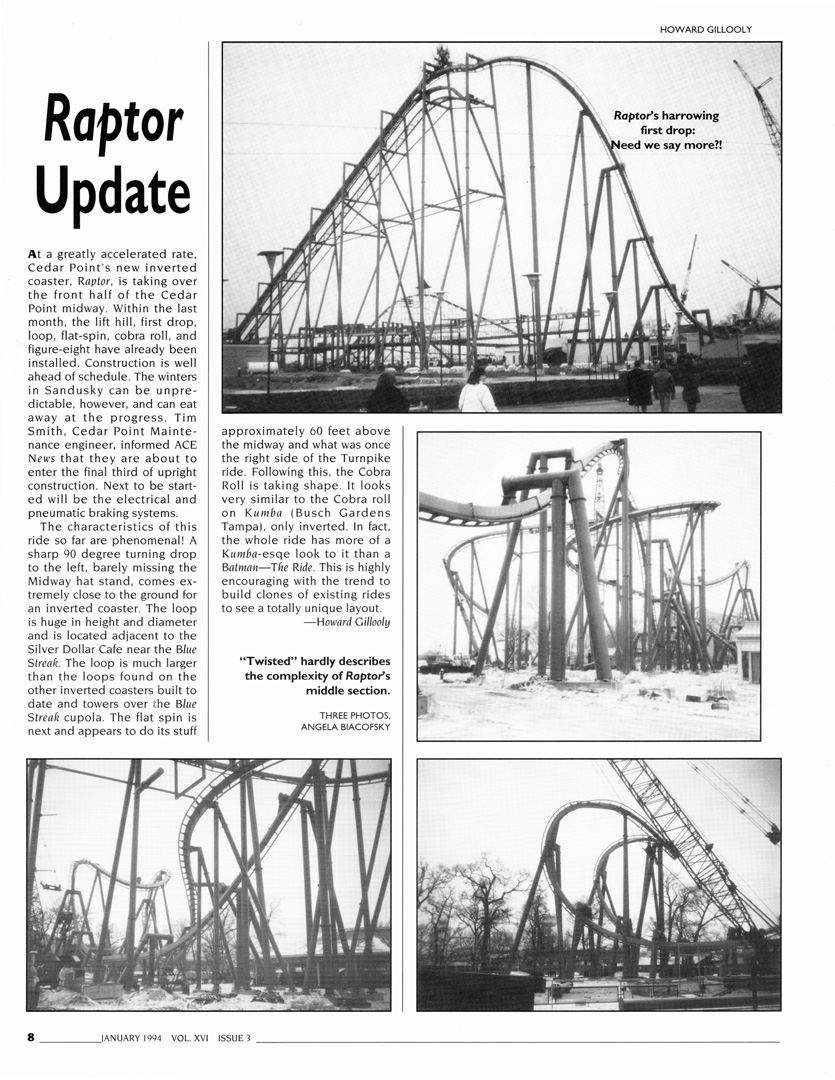
View full-sized image.
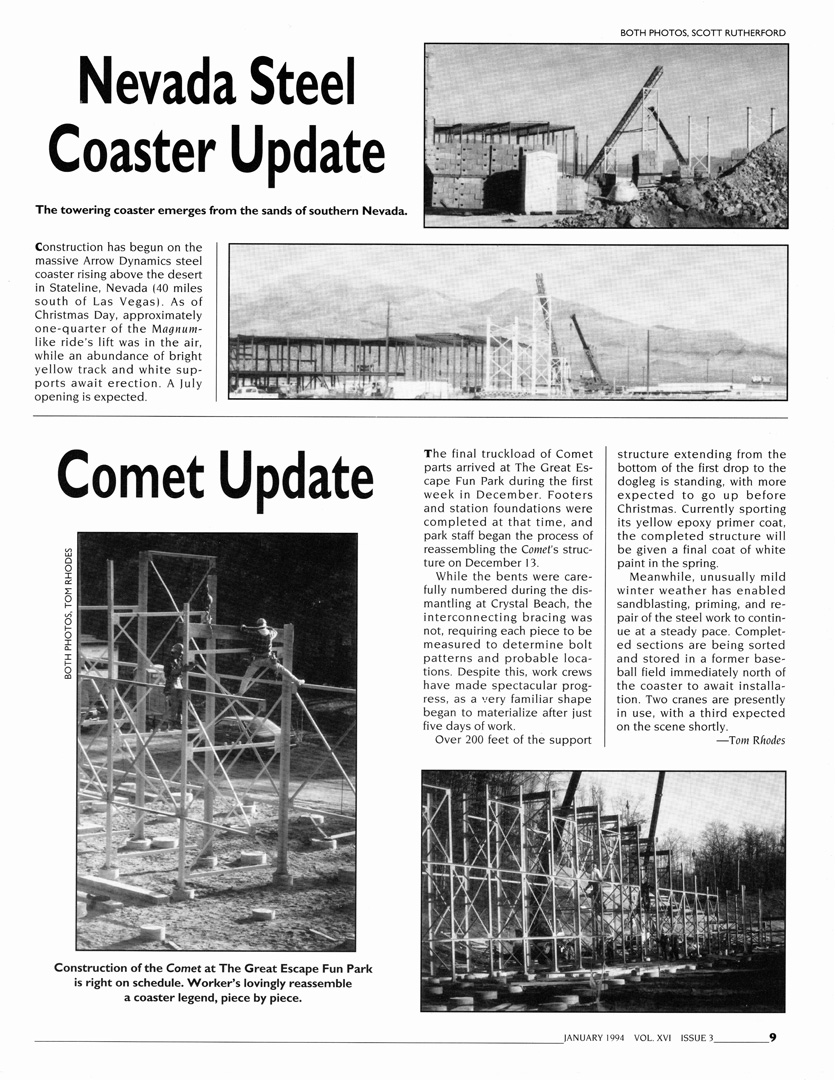
View full-sized image.
Raptor, Cedar Point
Displaying experience and professionalism uncommon to fledgling companies, Bolliger & Mabillard (B&M) made headlines and arguably altered the course of the amusement industry with the debut of its Batman The Ride inverted coaster at Six Flags Great America (Gurnee, Illinois) in 1992. A total of 12 versions of the time-tested design would ultimately be constructed in the following years — many at other Six Flags properties — while a different but similarly sized inverted design found its way to Paramount’s Great America (now California’s Great America, Santa Clara, California) as Top Gun (now Flight Deck) in 1993.
In 1994, Cedar Point (Sandusky, Ohio) did what Cedar Point often does and opened a B&M inverted coaster that offered more than the competition — more height, more speed, more length and more inversions (including the first-ever cobra roll on an invert). Raptor followed other noteworthy additions at the famous park on the Lake Erie peninsula, including 1989’s Magnum XL-200 and 1991’s Mean Streak; it also marked the first time a coaster with inversions was built at the park since 1976’s Corkscrew, which remained the only coaster at the location to toss riders upside down for 18 seasons.
Needless to say, Raptor was extremely well-received by coaster enthusiasts and is still considered by many as an excellent example of the breed, offering a level of intensity that surprises first-time riders. With quick transitions and crushing positive forces, it remains a stunning example of B&M’s early work, which is a sharp contrast to some of its later (and different) design sensibilities highlighted on Banshee at Kings Island (Mason, Ohio), three hours away on the other side of the state.
— Rob Ascough, ACE News Editor
Desperado, Buffalo Bill’s Resort & Casino
Something remarkable about Magnum XL-200 at Cedar Point (Sandusky, Ohio) is the fact that it took other parks five years to attempt to replicate the success of Arrow Dynamics’ first hypercoaster; following three more in 1994, no others ever got built. What’s even more intriguing is that one of those three was constructed not in an amusement park like the other two (Pepsi Max Big One, Blackpool Pleasure Beach, Blackpool, Lancashire, England, United Kingdom) and Titan (Space World, Yahata Higashi, Kitakyushu, Fukuoka, Japan) but outside of Las Vegas at Buffalo Bill’s Resort & Casino, where it was joined by some other amusements, including an indoor log flume.
Despite noteworthy statistics including more than a mile of track and a 225-foot first drop dug into the desert sand, the coaster’s out-of-the-way location resulted in low ridership, and in later years the amusements at the casino resort would close during the slower winter months. With Buffalo Bill’s now falling under the Primm Valley resorts umbrella, Desperado has been dormant since at least 2019, and there is no word on whether it will ever reopen.
— Rob Ascough, ACE News Editor
Comet, Great Escape
As Six Flags Great Escape in Queensbury, New York, prepares for the arrival of Bobcat for the 2024 season, it’s easy to forget the celebration among coaster enthusiasts when it was announced that the legendary Crystal Beach (Crystal Beach, Ontario, Canada) Comet was finally going to be rebuilt at Charlie Wood’s Lake George, New York-area amusement park. This followed an unsuccessful plan to get it installed at the other amusement park he owned at the time — Fantasy Island on Grand Island, New York, which was also where the coaster was stored following Wood’s purchase of the ride at auction.
A true piece of history, Comet can be traced back to the notorious 1926 Crystal Beach Cyclone — the longest-surviving example of Harry Traver’s “Giant Cyclone Safety Coasters” that included the Revere Beach (Revere Beach, Massachusetts) Lightning and Palisades Park (Fort Lee, New Jersey) Cyclone. In response to decreasing ridership, Herbert Schmeck of the Philadelphia Toboggan Company was hired to transform Cyclone’s steel structure into a double out-and-back that proved popular with park guests owing in part to its plentiful airtime and gorgeous waterside location.
Comet was regarded as one of the world’s best wood coasters from its debut in 1948 until the park’s closing in 1989; this reputation for greatness continued when it debuted at Great Escape in 1994, where it is still considered a prime example of a classic wooden creation.
— Rob Ascough, ACE News Editor
What a treat to read about the preservation and re-erection of the dismantled Crystal Beach Comet finding its new home in 1994 at The Great Escape Fun Park (now known as Six Flags Great Escape), with ACE News in its January 1994 issue offering some great pictures showing the park’s workers lovingly reassembling “a coaster legend piece by piece,” eventually leading to the Comet woodie reopening on June 25.
The Comet continues to thrill riders to this day. What is especially notable is that Six Flags Great Escape — 30 years after it debuted its first woodie (the resurrected Comet) — is now proudly opening its second woodie, Bobcat (a Gravity Group, LLC creation), bringing Great Escape’s coaster count to six in 2024, fortunately including two woodies.
— Randy Geisler
#ACENews