originally posted on 7/1/2024
View full-sized image.
View full-sized image.
Published here is a small portion of the May-June 1999 issue of ACE News, but I suggest a download of the full issue to get a better overall idea of the state of the amusement industry at the time, which I believe to have been the most exciting of my years in this hobby. As an enthusiast who loves Bolliger & Mabillard (B&M) coasters almost as much as wooden ones, I’m not sure I’ll ever witness another moment like this.
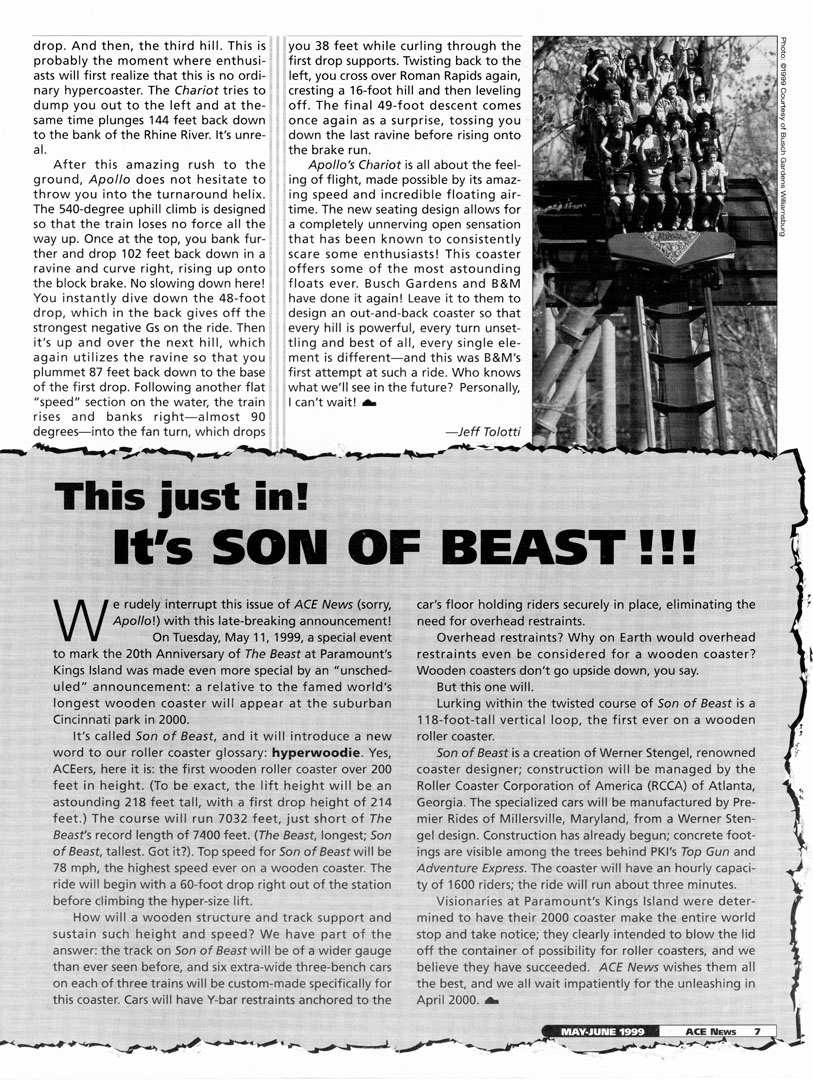
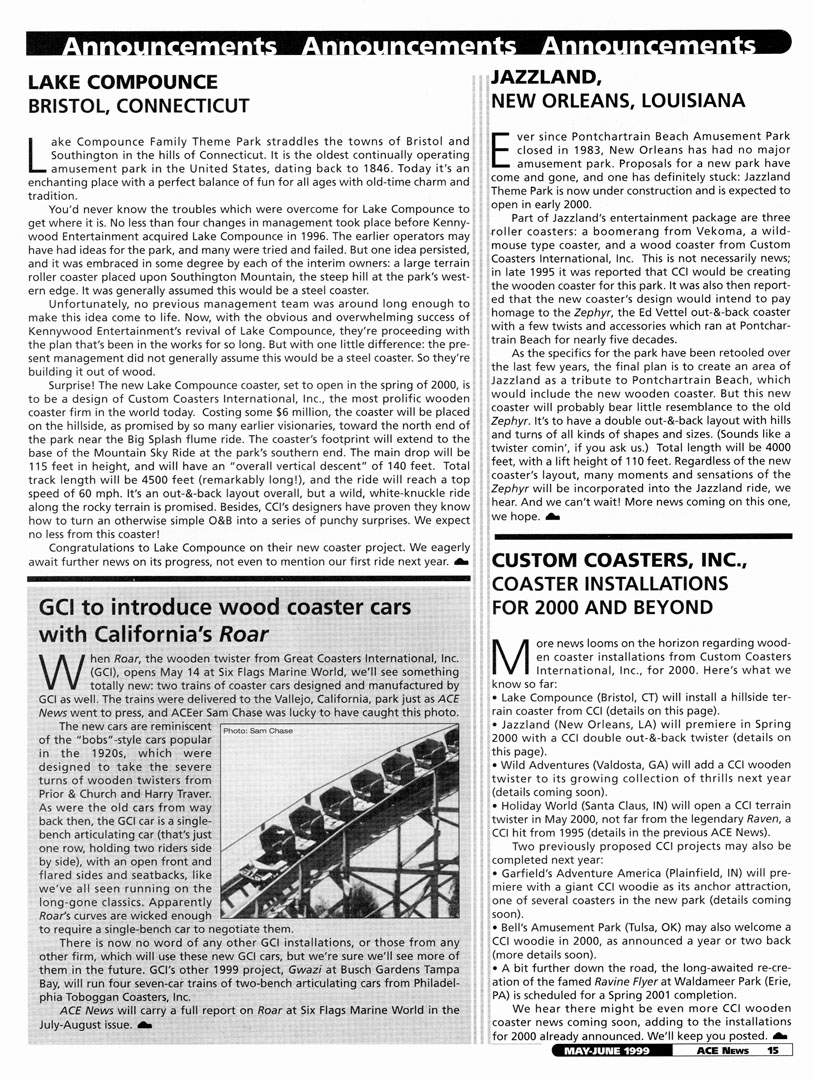
For the 2000 season, Custom Coasters, Inc. (CCI) was juggling a lot of projects. Some didn’t happen right away — the twister at Wild Adventures (Valdosta, Georgia) became an out-and-back called Cheetah for the 2001 season, and the re-creation of Ravine Flyer at Waldameer (Erie, Pennsylvania) would have to wait even longer, eventually being designed and built by The Gravity Group after CCI’s closure. Others, like the proposed coasters for Garfield’s Adventure America (Plainfield, Indiana) and Bell’s Amusement Park (Tulsa, Oklahoma) never happened at all. But Boulder Dash at Lake Compounce (Bristol, Connecticut), The Legend at Holiday World & Splashin’ Safari (Santa Claus, Indiana), MegaZeph at Jazzland (New Orleans, Louisiana) and some others yet to be announced leapt from imagination to reality. In addition, Great Coasters International, Inc. debuted its new Millennium Flyer trains on Roar at Six Flags Discovery Kingdom (Vallejo, California), while Kings Island (Mason, Ohio) took things many steps further by announcing Son of Beast, which made headlines for being the first wood coaster in the modern era to feature an inversion. It was a good time to be a lover of wood coasters, though the era was a short one — a depressingly small number of the coasters just mentioned are still in operation a mere quarter of a century later.
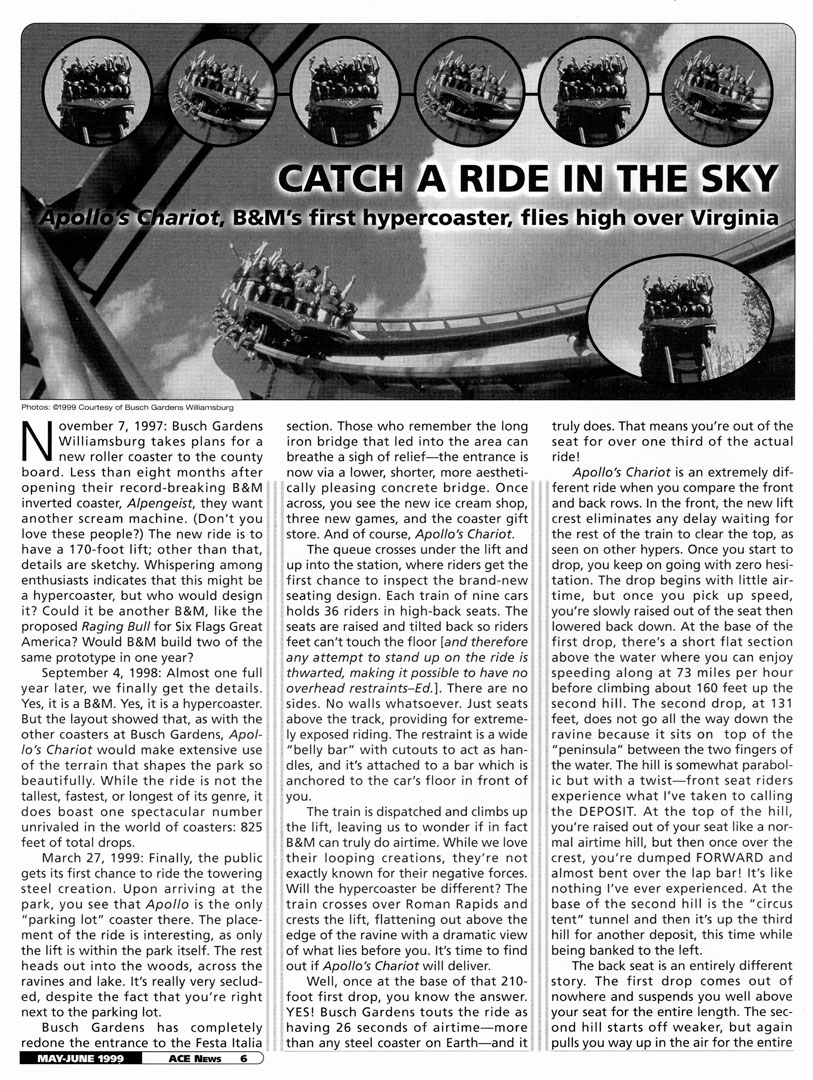
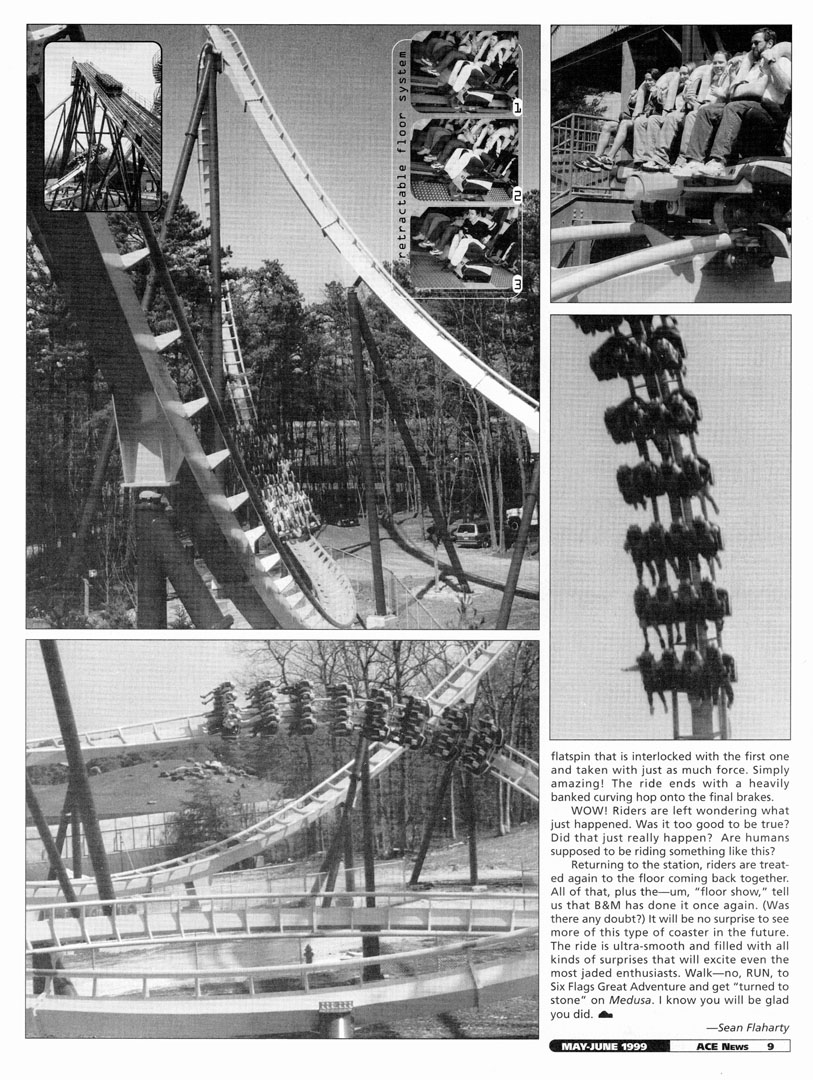
The B&M coasters that ACE News reported on in 1999 had much better luck in the realm of longevity, and it can be argued that much of what the company created for the 1999 season laid a lot of its groundwork for the ensuing decades. Medusa at Six Flags Great Adventure (Jackson, New Jersey) combined two of the company’s roller coaster styles — the standard looping coaster and its wildly popular inverted coaster — into something called the floorless coaster. To this date, a dozen examples have been built throughout the world. Meanwhile, Apollo’s Chariot at Busch Gardens Williamsburg (Virginia) represented one of the firm’s first two hypercoasters — a type of coaster that hadn’t yet become an industry standard. Many coaster enthusiasts now regard B&M hypercoasters as some of the best coasters in the world, including the company’s subsequent foray into gigacoasters (though it doesn’t make a distinction between coasters above and below 300 feet in height).
It is perhaps fitting that in an issue dominated by the works of B&M (its Georgia Scorcher standup at Six Flags Over Georgia in Austell and Top Gun: The Jet Coaster invert at Carowinds in Charlotte, North Carolina, are also highlighted in the pages), the first new Arrow Dynamics roller coaster in quite a few years is also on display. Tennessee Tornado represented a huge step forward for Dollywood (Pigeon Forge, Tennessee), simultaneously remaining a solid family park while establishing itself as a thrill ride capital. Although the coaster was one of the best rides Arrow ever produced, it would be among the company’s last. Not much later, the company went bankrupt and ceased operations.
There’s almost too much to read — always a hallmark of ACE News — and if you run out of news and new ride reports, there’s always the healthy classifieds section on the last page. Talk about a throwback… er, Switchback.
— Rob Ascough, ACE News Editor
View full-sized image.

View full-sized image.
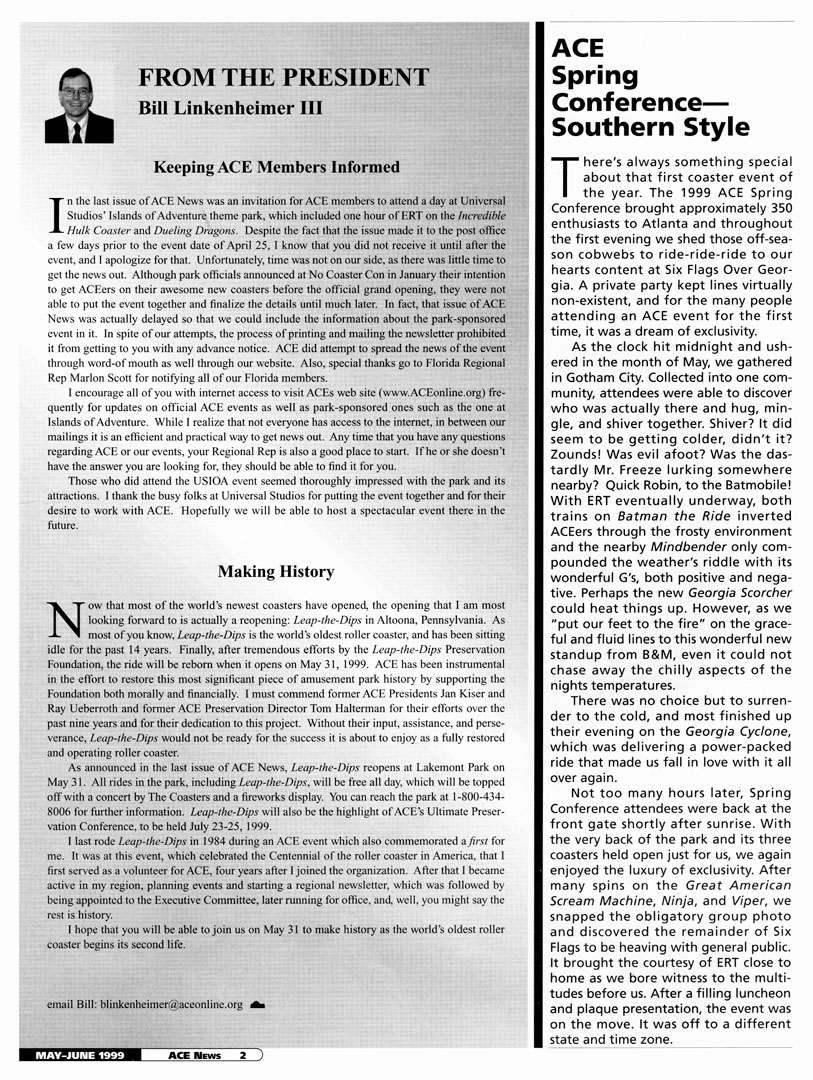
ACEers would be wise to note then-President Bill Linkenheimer III’s marvelous “From the President” column (I have personally joked that the still-great Bill is among the two finest prezes ACE has ever enjoyed), wherein he expresses regrets that ACE could not get the word out fast enough about an event at Universal Studios Islands of Adventure (Orlando, Florida), including ERT on its new Dueling Dragons B&M double-track monster. Ah, the hassles of the days before ACE could take advantage of the internet, but also highlighting the importance of ACE’s leadership and volunteers being able to communicate the problems and accomplishments of ACE’s workings, in this case via ACE News.
Linkenheimer also touts how ACE had helped in “Making History” with the reopening of the historic Lakemont Park (Altoona, Pennsylvania) Leap The Dips side-friction woodie. He kindly and appropriately thanked Jan Kiser, the late Ray Ueberroth and Preservation Director Tom Halterman for their efforts, along with ACE’s overall endeavors both morally and financially, to save the coaster. Leap The Dips did operate happily, from 1999 to 2016, and then again from 2020 to 2023, but now how sad and ironic it is to remark that we are again faced with the dilemma and challenge of how to revive the again-sadly standing but not operating Leap The Dips. Let’s all hope ACE will succeed once more, just like it did in the years leading up to 1999.
A read of this issue is also to revel in the marvelous article (written by Jeff Tolotti) celebrating the opening of Apollo’s Chariot steel hypercoaster at Busch Gardens Williamsburg, which still rides high to this day, with the fine article interrupted by the early announcement of the Son of Beast megawoodie to be built at Kings Island and opened in May 2000. Son of Beast was the tallest wooden roller coaster ever built, standing at an incredible 200 feet. The height made it the world’s first (and to this date, only) wooden hypercoaster. But what a magnificent failure the woodie would unexpectedly turn out to be, as after numerous problems and changes, the ride closed in June 2009. What an amazing time it was back then to contemplate that such a wonder of a coaster could be created.
— Randy Geisler
View full-sized image.
View full-sized image.
Wow, 1999 was definitely one of B&M’s busiest years. The company created two first-of-a-kind coasters that year with the opening of its first hypercoaster, Apollo’s Chariot, at Busch Gardens Williamsburg and first floorless looping coaster, Medusa, at Six Flags Great Adventure. Adding to B&M’s lineup that year was also Top Gun: The Jet Coaster (now called Afterburn), a custom-built inverted roller coaster at Carowinds, along with another new stand-up coaster, Georgia Scorcher, at Six Flags Over Georgia. If that weren’t enough, three more coasters would open that year with Incredible Hulk and the dual-tracked Dueling Dragons (Fire and Ice) at Universal Orlando’s brand-new Islands of Adventure theme park. It was certainly a good year to be a fan of B&M coasters (of all the B&Ms built that year, only Dueling Dragons was lost in 2017, after having been rethemed to the Harry Potter Dragon Challenge in 2010).
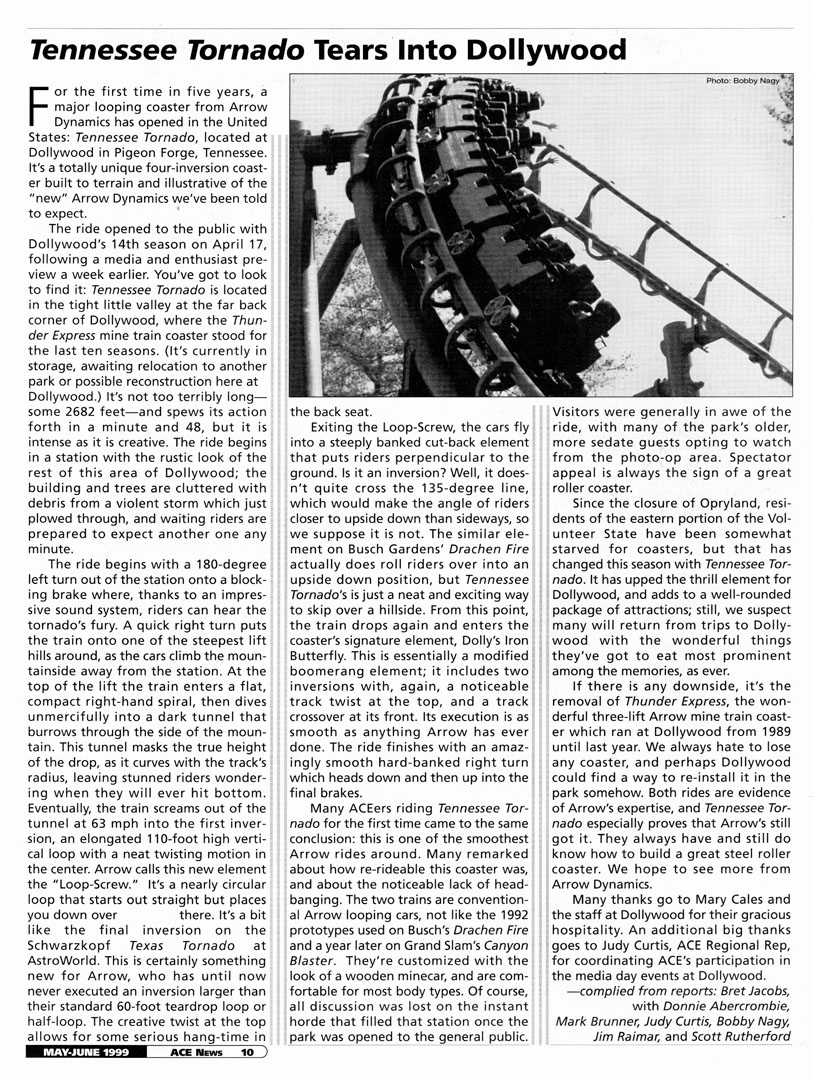
Other new coaster news in the issue included what would be one of Arrow’s last looping coaster designs, Tennessee Tornado at Dollywood. It’s a shame that Arrow disappeared just a few short years later, as this was perhaps one of Arrow’s best looping designs. Arrow, the pioneer of steel roller coasters, would fade away, but at least Tennessee Tornado still stands as a true testament of what the company was capable of building.
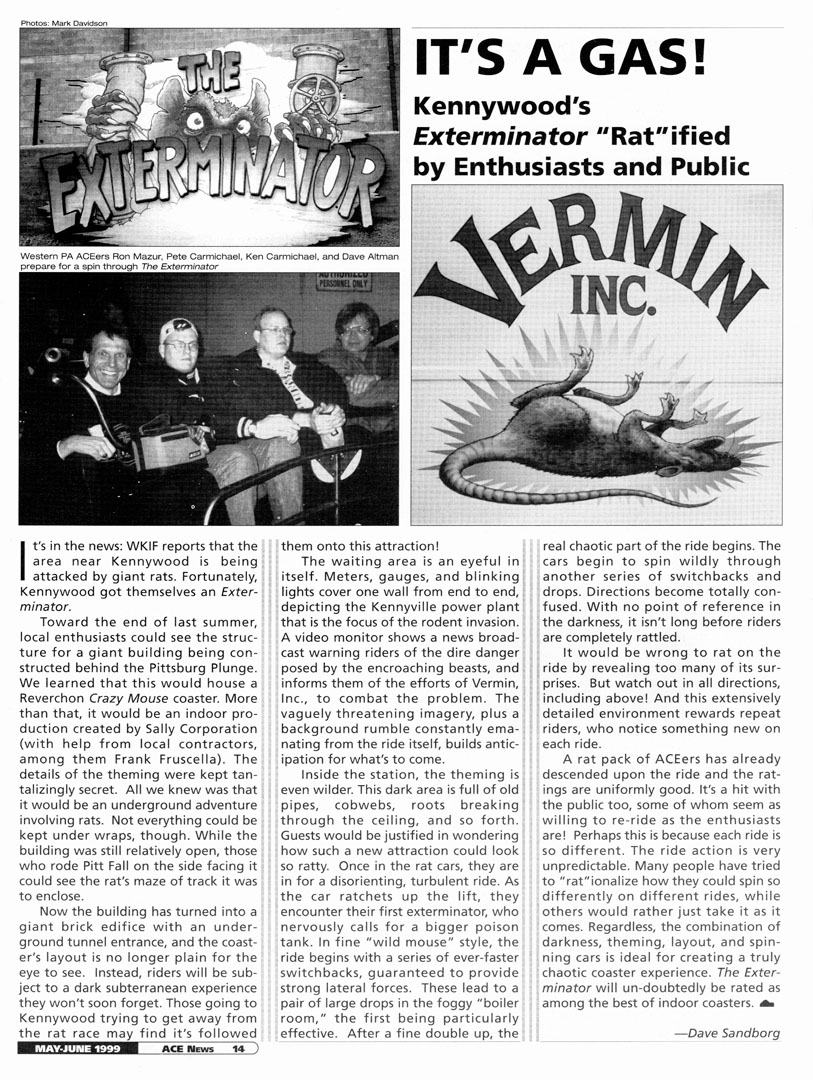
A fun new coaster addition that year was The Exterminator at Kennywood (West Mifflin, Pennsylvania). I personally attended the media preview — who would have known that installing a Reverchon spinning crazy mouse in a dark building with terrific theming could be so fun? It quickly became one of Kennywood’s most beloved coasters and is still popular today, proving that a park doesn’t always need a record-breaking coaster.
Then-ACE President Bill Linkenheimer III mentioned the importance of the reopening of Leap The Dips at Lakemont Park. Sadly, Leap The Dips won’t be operating this year for its 25th grand reopening celebration. It will just sit quietly with its wooden neighbor, Skyliner, slowly deteriorating. It is hoped that both coasters will reopen again someday. It’s equally important today to keep these historic coasters operational, especially Leap The Dips.
— Dave Hahner, ACE Historian
View full-sized image.
View full-sized image.
#ACENews