originally posted on 2/24/2025
Photo: courtesy NRCMA. View full-sized image.
Celebrating more than 150 years of history, the National Roller Coaster Museum and Archives (NRCMA) welcomed ACE members to join a digital tour of the facility, showing off many items that are part of the collection. Kris Rowberry, NRCMA board member and ACE volunteer, was the tour guide, with fellow ACE volunteer Rachel Hawkins manning the camera. They took attendees on a complete tour of the more than 20,000-square-foot facility in Plainview, Texas.
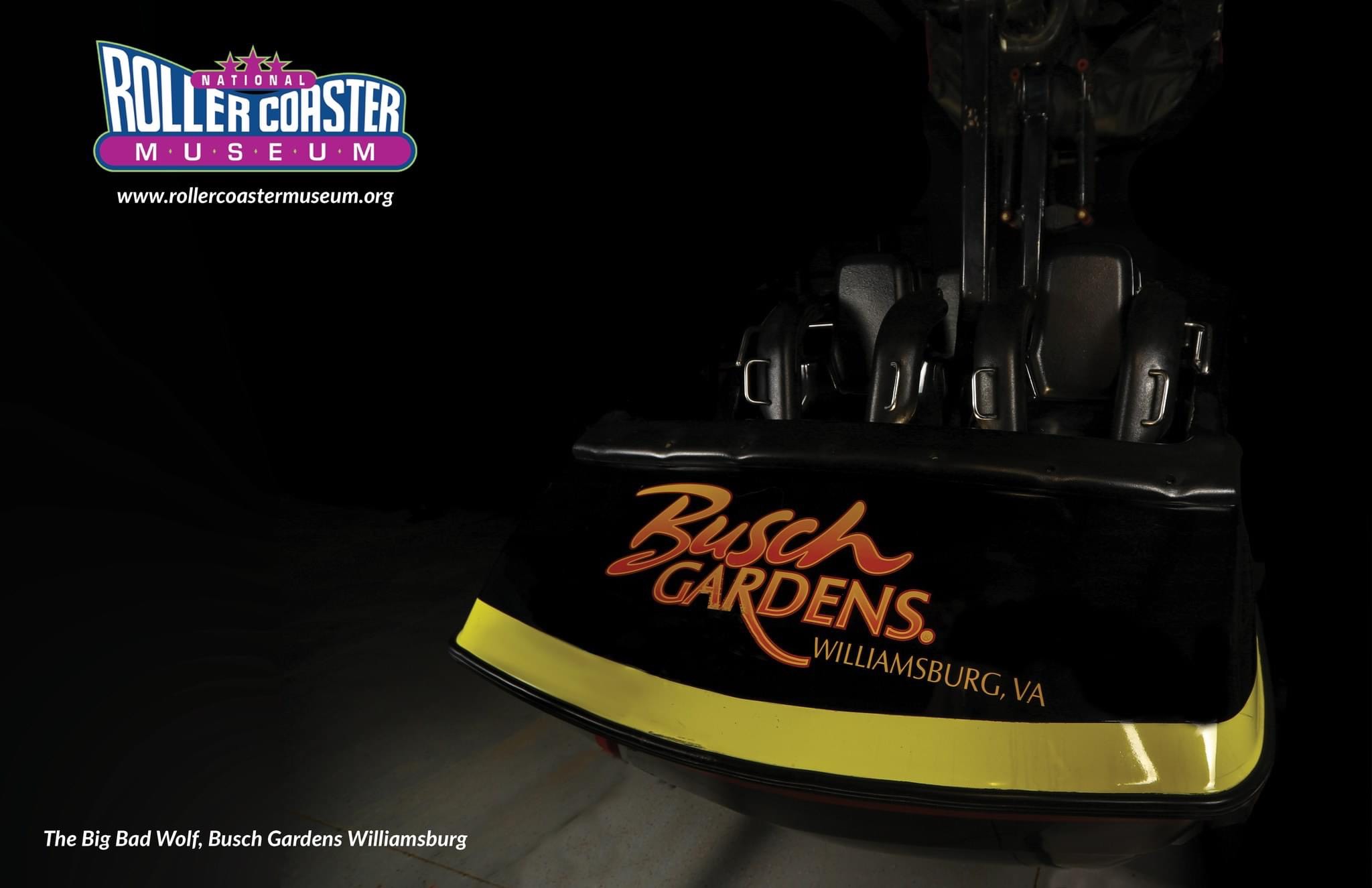
Big Bad Wolf.
Photo: courtesy NRCMA. View full-sized image.
First on the agenda was one of the most requested sights: Big Bad Wolf. Not only did the ride sign still light up, but the restraints on the car are still fully operational. This was followed by signage from several defunct parks, including Joyland Amusement Park (Lubbock, Texas) and Six Flags AstroWorld (Houston, Texas), which stirred memories of what was lost. It would not be the last emotional moment on the tour.
Next was what Rowberry called, “...the most emotional piece in the museum’s collection,” a park map and ride signage from Six Flags New Orleans (Louisiana). They were positioned on the wall at the same height as they were in the park during Hurricane Katrina and still showed the waterline, illustrating just how devastating the storm was.
This was all in the first of five buildings, which ended with a look into a huge tractor trailer filled with items yet to be organized and cataloged.
Going into the second building, the tour turned to a highly themed Arrow Development vehicle from Snow White’s Scary Adventure at Walt Disney World’s Magic Kingdom (Orlando, Florida). “Dopey” is close to another Disney vehicle, this time from DisneyQuest and Buzz Lightyear’s Astro Blasters.
After taking a peak at the large Kiddieland sign from Chicago (Illinois), attendees entered the archive room, where thousands of documents and other smaller pieces are stored. Hundreds of boxes lining the walls are filled with old blueprints, park maps, ride concepts and more.
This room also houses a topographic 3-D model of Tennessee Tornado from Dollywood (Pigeon Forge, Tennessee) and an original park map of Six Flags Over Texas (Arlington). There were so many different things to see here that it was no surprise to many on the tour to hear about the variety of additional items that are being added to the collection and the need for a museum expansion to house all the archives.
Heading out of the archive room, ACEers were greeted by the lead car from Volcano: The Blast Coaster at Kings Dominion (Doswell, Virginia). The vehicle from the world’s first launched inverted coaster is due for a cleaning and detailing before being put on display but was still a delight to see.
From modern to almost ancient: the museum houses nearly the entire span of roller coaster history. Next to Volcano: The Blast Coaster’s vehicle was a newly acquired car from Fire In The Hole at Silver Dollar City (Branson, Missouri) and a 1918 side friction vehicle from Rocky Springs in Lancaster, Pennsylvania.
Chance Rides donated a train engine that had been converted from steam to compressed air, making it easier to maintain and display. Rowberry also showed a magnetic brake and demonstrated just how much force it provides.
The now-defunct Joyland Amusement Park donated its original signage from the park entrance. This is housed near the Shockwave TOGO car from Kings Dominion (Doswell, Virginia). This exhibit (as well as others in the museum) displays the stats from the rides. There are years and locations to help museum-goers put the items they see in a timeline. This includes 1971’s Big Bend from Six Flags Over Texas, which is housed in the museum.
Heading into the third addition to the “long building,” attendees saw a vehicle from Avalanche Run/Disaster Transport, an Intamin bobsled, at Cedar Point (Sandusky, Ohio). Rowberry announced that Six Flags Over Texas is donating a single-row bobsled from La Vibora, which will allow for the comparison once it is set up in the museum.
There were some great pieces of an Eli Ferris Wheel and an original freefall car from Texas Cliffhanger. Next was a dynamic display of Mantis from Cedar Point. Rowberry shared that many entering the room actually think the train is broken, but it was purposely displayed at an angle to show off the articulation.
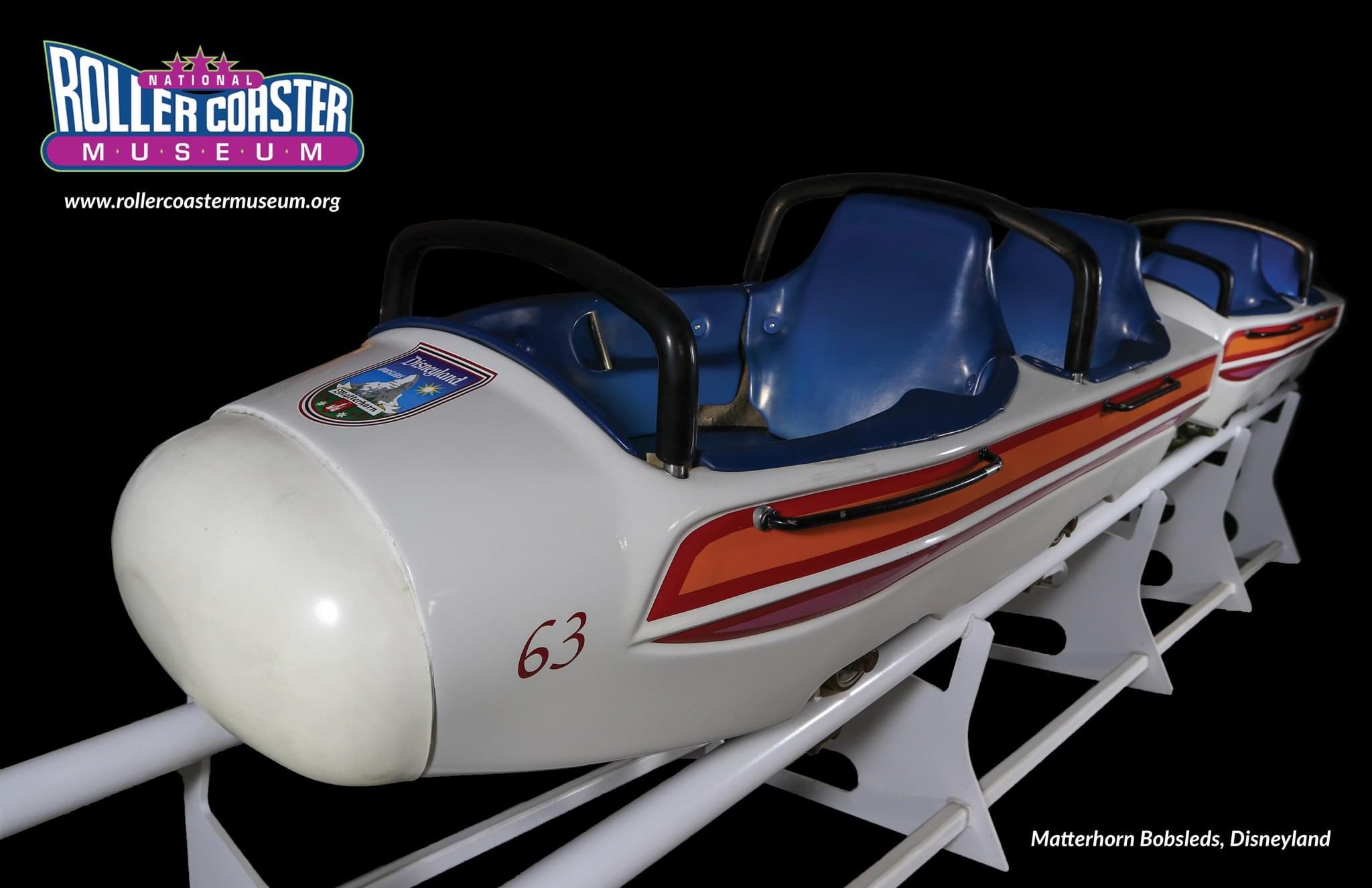
Matterhorn Bobsleds.
Photo: courtesy NRCMA. View full-sized image.
Some signage from Great American Scream Machine at Six Flags Great Adventure (Jackson, New Jersey) was next. This had a place of honor, next to Matterhorn Bobsleds from Disneyland (Anaheim, California) — a rarity the museum is really excited to have in its possession. It was next to the sign from the original California Screamin’ at adjacent Disney California Adventure, which is still operational.
The water ride collection featured a log from the Texas Splash Down flume, a SeaWorld San Antonio ride. This display also included the launch system from the ride.
There was also an entire wall dedicated to the Mouse collection — as the name implies, vehicles from Wild Mouse-style coasters — which varied widely and included some cars from rides such as the defunct Miler Manufacturing Tree Top Racers at Adventure City (Anaheim, California).
Full-sized rides make up the bulk of the on-display collection, but there are also some scale models that have been donated by parks and from personal collections. Some of these models represent rides that have been built and ridden, while others are dreamt rides that never became full-scale versions. One thing these models have in common is none of them has been built at the museum, and models are not built with an eventual move in mind. While they are still aesthetically pleasing and conjure dreams of a great ride in the museumgoers head, when they are turned on, some of the trains do not move as seamlessly through their tracks as they once did. Restoring the functionality of these models is one of the future projects of the NRCMA. The model collection spans different coaster and even ride types, with one being a fully operational Tilt-A-Whirl model. This miniature is incredibly ornate with completely turning cars and fully functional lights around the outside of the system.
The museum also has a theater room that can show moving images that are relevant to the displays at any given time. It is currently showing “The Legacy of Arrow Development” documentary.
The theater room is next to the Mark Moore Wing, a full 20,000 square feet of space. This room houses a huge number of coaster cars as well as some of the tracks that supported these rides. The second floor of this wing includes a piece of Big Bad Wolf track as a support for the staircase. Once visitors reach the top of this staircase, they are standing on original ledgers from Gwazi at Busch Gardens Tampa Bay (Florida), saved by Rocky Mountain Construction (RMC) when they were reworking the ride.
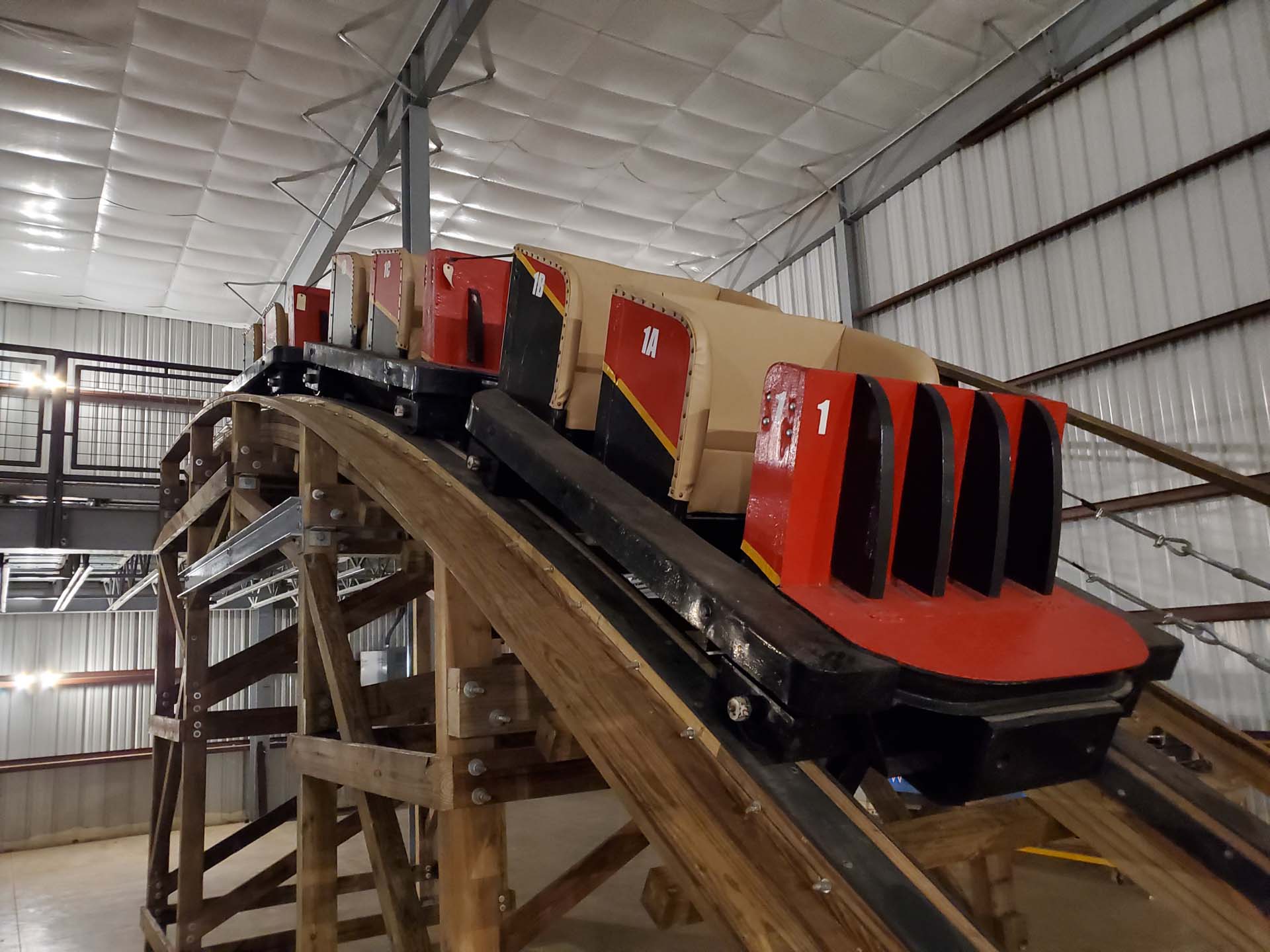
Rollo Coaster.
Photo: Alex Rigsby. View full-sized image.
This room has vehicles from many places, both the United States and abroad. One is from sooperdooperLooper at Hersheypark (Hershey, Pennsylvania), which restored its train and then sent it to the NRCMA. A vehicle from Rollo Coaster at Idlewild (Ligonier, Pennsylvania) is also displayed on track built by Great Coasters International, Inc. in this room next to the Philadelphia Toboggan Company trains from Wildcat, Lake Compounce (Bristol, Connecticut). Ancient vehicles more than a century old are displayed on tracks built to current code, showing the juxtaposition of new and old. Some open spaces suggest the potential exists for more train cars to be added in the future.
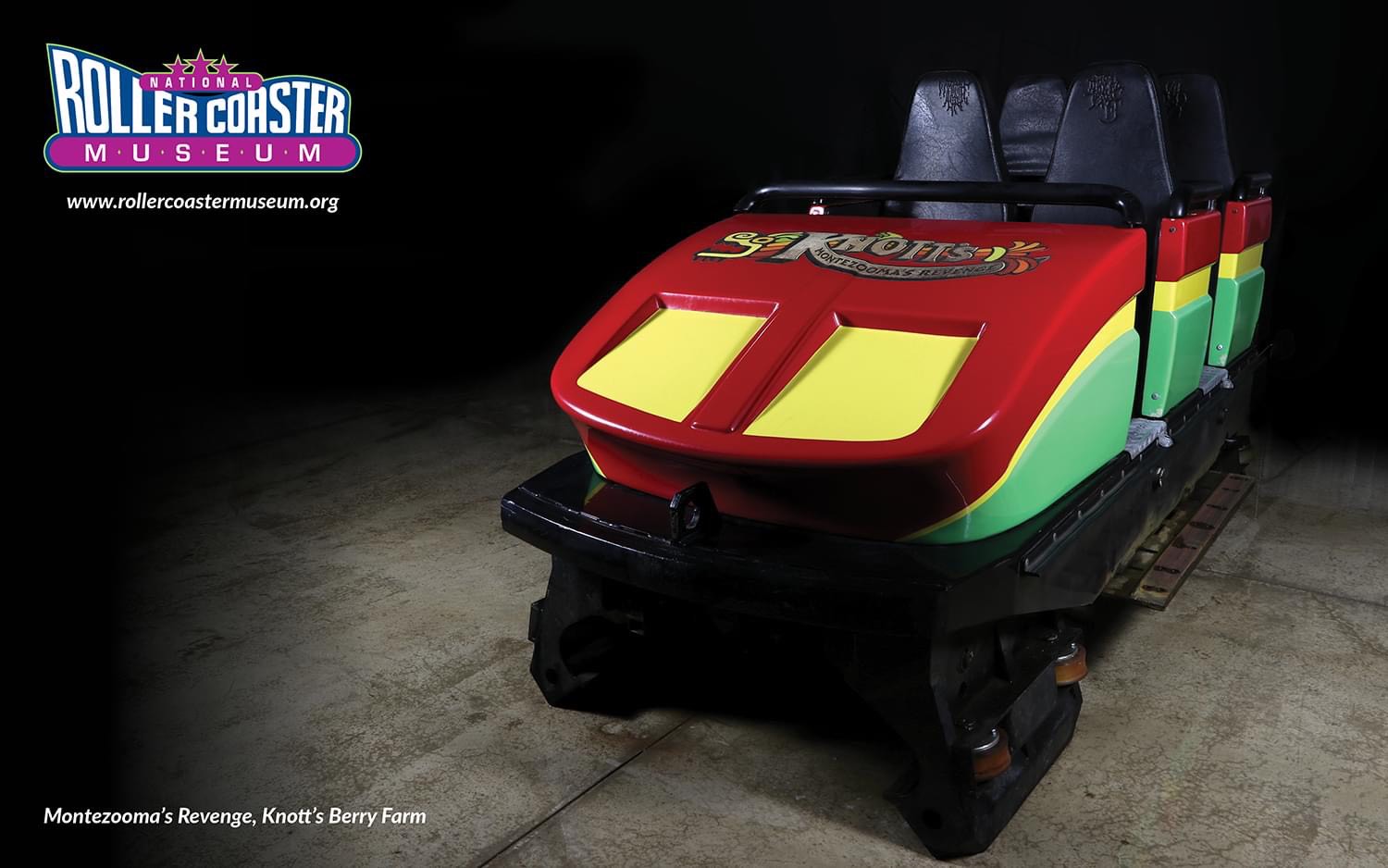
Montezooma’s Revenge.
Photo: courtesy NRCMA. View full-sized image.
Other pieces shown during the tour include an original Morgan wood coaster car from Rattler at Six Flags Fiesta Texas (San Antonio) and a Knott’s Berry Farm Montezooma's Revenge car — both of which are sporting some old-school lap bars. Also seen was a Mack Rides Eurosat lead car from Europa-Park (Rust, Germany) with working lap restraints, along with Canobie Corkscrew trains from Canobie Lake Park in Salem, New Hampshire, and the parts necessary to restore and support these vehicles. The tour included a full 360 walkaround of the car, with an opportunity to see the locking mechanism housed in the back of the car.
There was also mention of some of the museum’s future projects. One is centered on a vehicle from Six Flags Magic Mountain’s (Valencia, California) Revolution. The museum’s goal is to restore the original coloring and shape from the 1970s by removing the current color wrap and altering the headrests, which were updated over the years.
At this point, it was mentioned that two years ago, ACE member Randy Duffer donated his fully restored Lakeside Amusement Park (Denver, Colorado) Derby Racer car from 1911 — a project he had worked on for more than 20 years!
There were also donations from Pacific Park, formerly Santa Monica Pier (California), one of the most photographed and filmed parks in the world, and a fiberglass shell from Loch Ness Monster at Busch Gardens Williamsburg (Virginia). Of special interest was the front car from a Schwarzkopf Looping Star — the world’s first portable looping coaster. It still had the original Schwarzkopf logo on the side, which is rare since many fell off or were stolen over the years.
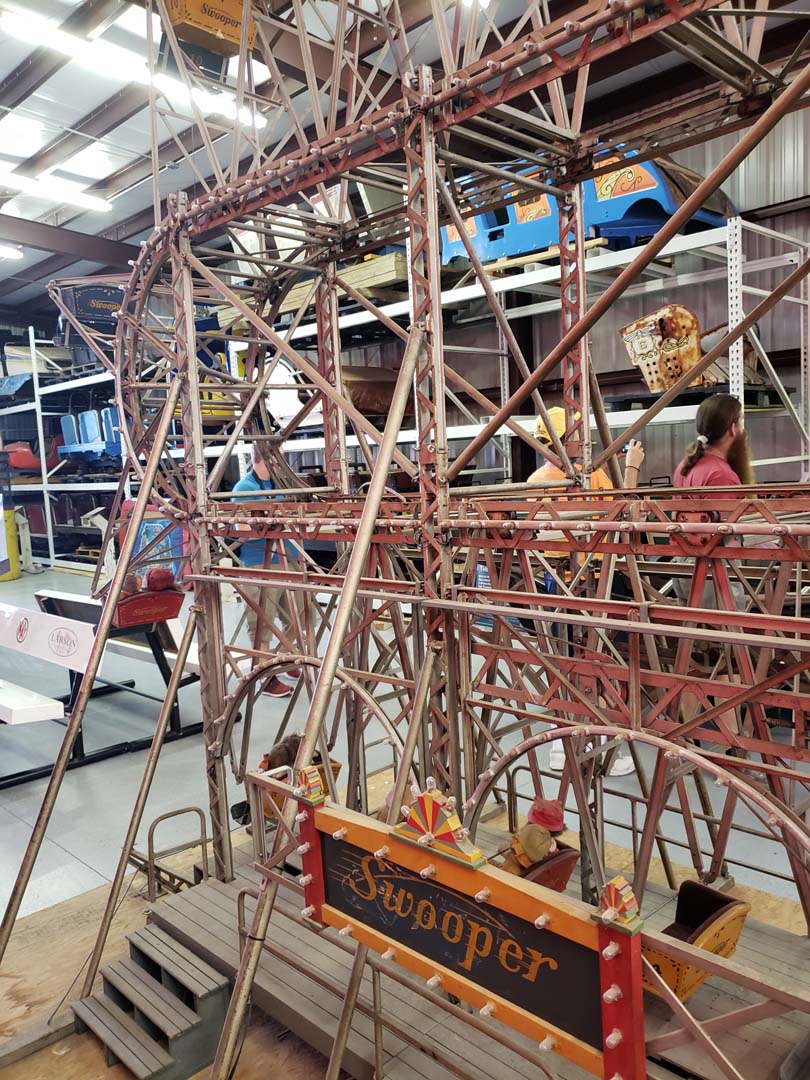
Swooper
Photo: Tim Baldwin. View full-sized image.
This massive room also houses the Selner zipper-like Swooper ride, which was displayed near the Schwarzkopf Wildcat car from Cedar Point. Of historical interest, the Wildcat cars originally were constructed from pared-down automobiles. Nearby was a nonoperational coaster train car from Dollywood’s Thunderhead — a replica used as an IAAPA Expo display piece without a restraint system for showing off the car and logo.
At this point in the tour, Rowberry was asked if he has a favorite in the museum. He found this difficult to answer, but shared both Matterhorn Bobsleds and Montezooma’s Revenge memories, suggesting that those pieces are tied for his favorite. The emotional connection is what’s significant for him: “Everyone has a story about these rides, and if there is ride you have a story about, you are right back there, you hear the ride operation, remember that moment.”
The museum holds pieces of theme park history beyond just rides. Included is a manual Skee Ball machine, which has a paddle system for scoring. Points are generated through the clacking mechanism, demonstrated by Rowberry. Attendees saw the back of the machine and the display mechanism for showing different scores and point systems.
Photo: courtesy NRCMA. full-sized image.
The museum tour ended with a reveal of the Buzz Bar, behind a barn door created out of wood from Texas Cyclone. The bar is filled with history and enjoyment. The bar has RMC road wheels that have been converted into bar stools, original hand brakes on the walls as well as wood from some original rides mounted to the wall to show off the different wood types used by ride manufacturers through the years. Viewers could compare the wood grain and resilience. The wall houses cabinets built and donated by Larson, which hold a variety of coaster pieces. The bar itself was donated by RMC. It is one solid piece filled with old coaster pieces, and it is encased by the running bar from Mean Streak at Cedar Point. This bar was shown off originally during the Golden Ticket awards before making its way to the museum. Meanwhile, the wood in the chandelier is from Colossus of Six Flags Magic Mountain and is held up with Tilt-A-Whirl chains.
The NRCMA is always looking to preserve history, but it cannot do it alone. Merchandise purchases and museum donations are two ways ACE members can help with construction and new acquisitions. One hundred percent of donations go to the museum, as the board of directors is completely volunteer.
Any ACE member interested in seeing this amazing facility and more than 150 years of coaster and park history can attend the museum’s construction tour on Saturday, July 26. Members can register at: ridewithACE.com/events.
— Jes Niemiec, Digital Events Coordinator
#ACENews