originally posted on 10/21/2024
View full-sized image.
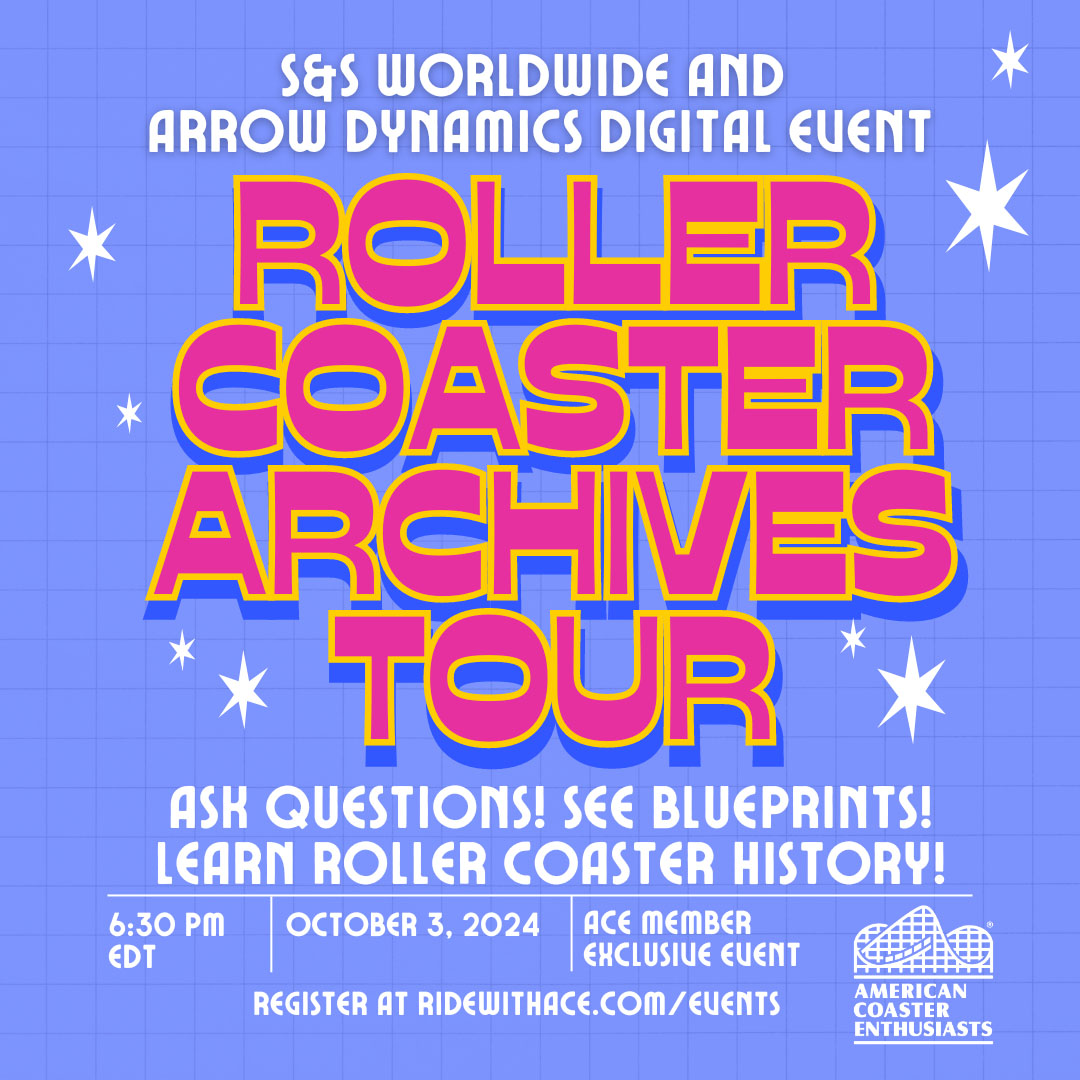
For the second time, S&S Worldwide was kind enough to offer ACE members visual access to its massive archives, showing off both S&S Worldwide ride elements and the acquired Arrow Dynamics archives. Preston Perkes, executive director of administration for S&S Worldwide, had a few team members with him, showing off their favorites among the wide variety available.
The event began with an overall look at the “attic” of the facility, including its many filing cabinets filled with drawings and blueprints from various projects done by the company throughout the years. Kaylee Mecham, sales and marketing assistant, pulled her favorite out of the drawer, showing some of the hand-drawn artistic renderings of rides and ideas from Arrow’s archives, including full-color and fully complete views of a pirate ride. The tour continued with a view of the reference manuals, so participants were able to see what clients would use once a ride was completed and fully operational.
One of the questions from members was whether S&S would have what is necessary to re-create a classic looper or suspended coaster if a park requested such a project. Unfortunately, the answer was that many of the older models would not be able to be replicated part-for-part owing to current safety standards. There are definitely elements of these classic rides included in experiences enjoyed today, including both inspiration and actual mechanical information that has been employed in the building of current rides.
Following this, Steven Mountford, project manager, showed engineering sketches displaying pieces and the connection of how the elements worked when assembling everything together. These items included pencil drawings of different ideas, and attendees were able to see places where the pencil was erased and altered as an improvement was made. Of these, some were classic rides that enthusiasts would be familiar with, and others were rides that were never fully constructed. S&S was able to show many great drawings, including some classic Disney rides when Arrow was working on Dumbo and Teacups, as well as old Arrow loopers. The company is beginning the process of converting some of the drawings into both microfilm for storage and digitized versions. The estimate was that it would take three full-time employees more than two years to digitize these plans because there are so many to convert.
Next, Joseph Pojunis, creative development engineer, showed participants his enthusiasm for 4-D roller coasters. He had a variety of photos for some of these projects and the modeling as it was progressing from the concept, to learning if it was a possibility, to shifts in molding and vehicle design. This included a puddy substance and tape to make changes as the best seats and highest degree of safety were achieved. The explanation went through construction from ideas to execution and park insertion. There were questions about the variations that are in the works and where one of these great rides can be ridden in the future.
The tour then went to some concept art of rides that have never seen a park, including the Arrow “Skyjumper” and other rides never built, including some large-scale models built with the Stratosphere in Las Vegas as reference. The ride vehicle in this instance used Barbie dolls as the scale reference for the ride. This was a different kind of coaster with a cage around passengers and a clear view of the Vegas strip.
Participants were then able to request photos from parks and projects from the past with pictures from a variety of angles to see the way the parts fit together and the evolution of building these rides. Some of the classic photos from Silver Dollar City (Branson, Missouri), Kings Island (Mason, Ohio) and Busch Gardens Williamsburg (Virginia) were requested. The most fully documented roller coaster shown was Drachen Fire, which included views of the track, the wheels, station and train, including some testing that took place with buckets and crates strapped into the train as weights replicating human riders.
A few additional rides included Marriott's Double Loop. The elements incorporated into this experience were shown in detail as ACEers were able to see the degree arc, bends and heights of different building stages. It was noted that in the past, the elements of older rides were built on site and that transitions were tighter than those of modern roller coasters. Subtle changes that are now possible are able to offer smoother ride experiences because current technology is significantly more advanced.
The next large project shown was the Marriott Antique Car final assembly with a bird’s-eye view of the ride vehicle from 1974. The process included one individual who drew the project, another who checked the drawing and an engineer who signed off on the drawing as ready for execution. There was also a Marriott flume drawing within these steps. The archives tour also looked at the pink requisition cards and the ways in which everything was preserved. This happened both to ensure the most positive outcome for clients purchasing the rides for their parks and to document which projects were purchased by whom so that maintenance could be ensured.
As the event was wrapping up, the balance between saving old elements and applying them to new projects came up. “We strive to follow and extend Arrow’s method,” explained Perke. “They were a very innovative company, and we try to follow in their footsteps.”
ACE digital events are an ACE member benefit and can be attended by members registering on ridewithACE.com/events.
— Jes Niemiec, Digital Events Coordinator
#ACENews